

platform-config.yaml or environment variables.
To set up your organization’s environment:
- Enter the organization’s name.
- Connect to an external database (required).
- Set up user authentication (basic or SSO).
- Apply your Console license.
We recommend using the Console UI (Settings > Clusters page) to configure Kafka cluster, schema registry and Kafka connect. This has several advantages over the YAML configuration:
- Intuitive interface with live update capabilities
- Centralized and secured with and audit logs events
- Certificate store to help with custom certificates configuration (no more JKS files and volume mounts)
Security considerations
- The configuration file should be protected by file system permissions.
- The database should have at-rest data encryption enabled on the data volume and have limited network connectivity.
Configuration file
platform-config.yaml
Bind file
Thedocker-compose below shows how to bind your platform-config.yaml file.
You can alternatively use environment variables. The CDK_IN_CONF_FILE variable is used to indicate that a configuration file is being used and the location to find it.
docker-compose.yaml
Environment override
Input configuration fields can also be provided using environment variables. Here’s an example ofdocker-compose that uses environment variables for configuration:
"docker-compose.yaml
Container user and permissions
Console runs as a non-root user, with user ID (UID) and group ID (GID)10001 by default. Since Console 1.35.0, it can also run with any other UID and GID, such as the ones OpenShift assigns. Console only writes to the /var/conduktor and /tmp volumes.
Configure memory usage
We rely on container CGroups limits and use up to 80% of the container memory limit for JVM max heap size.- Console helm
- Kubernetes
- Docker Compose
Configure SSL or TLS
Depending on the environment, Conduktor might need to access external services (such as Kafka clusters, SSO servers, databases or object storage) that require a custom certificate for SSL/TLS communication. You can configure this using:- Console UI (recommended) - you can manage your certificates in a dedicated screen and configure SSL authentication from the broker setup wizard.
- volume mount - this method is only required if you have LDAPS. Do not use it for Kafka or Kafka components.
Use the Conduktor certificate store
This option is recommended for Kafka, Kafka Connect and Schema Registry connections.
- .crt
- .pem
- .jks
- .p12
Upload certificates
You can add cluster configurations from Settings > Clusters page. When you add the bootstrap server to your configuration, a check will be made to validate if the certificate is issued by a valid authority. If the response indicates the certificate is not issued by a valid authority, you have two options:- Skip SSL Check: This will skip validation of the SSL certificate on your server. This is an easy option for development environments with self-signed certificates
- Upload Certificate: This option will enable you to upload the certificate (
.crt,.pem,.jksor.p12files), or paste the certificate as text
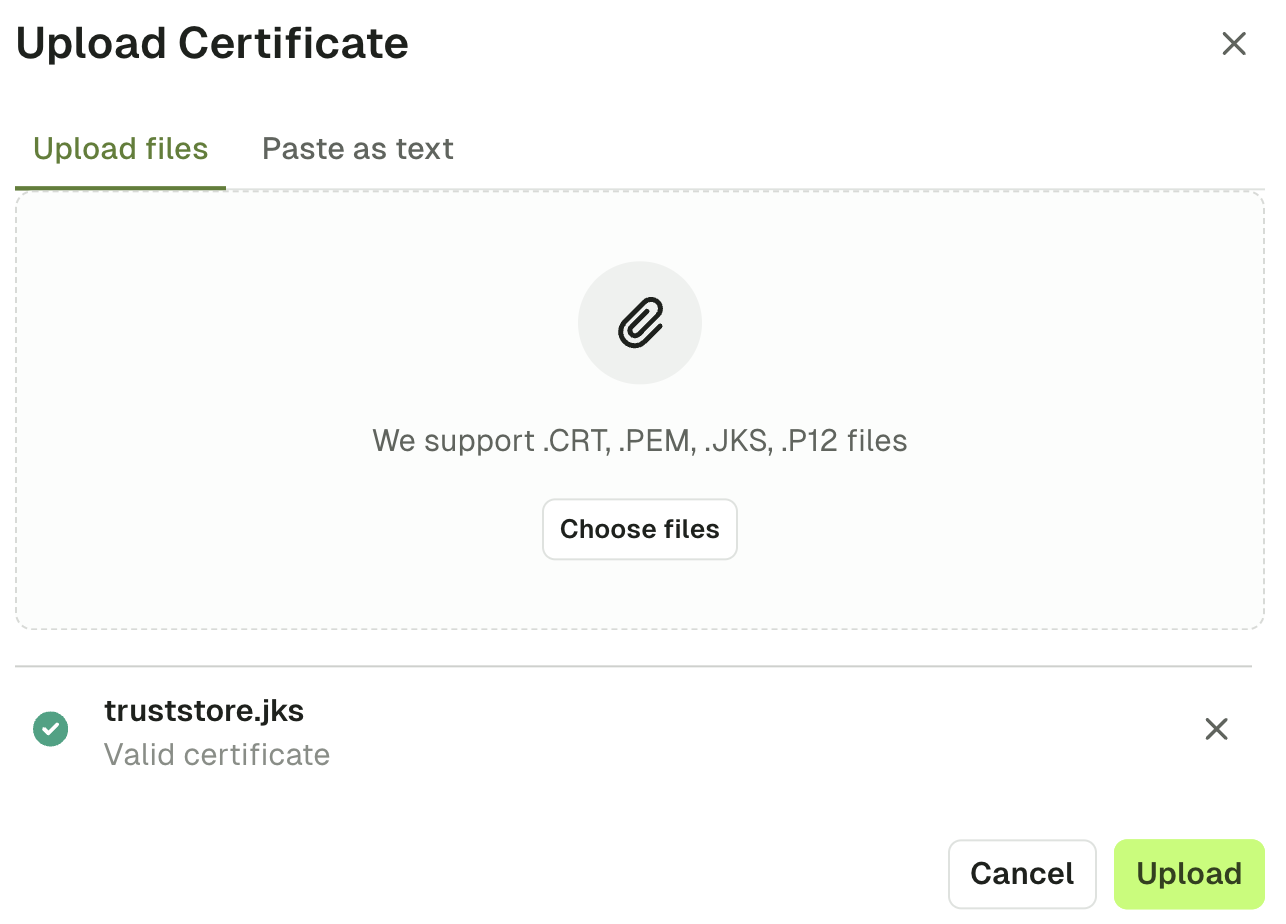

Add truststores
You can also manage organization truststores using the Settings > Certificates page. Simply add all of your certificates by uploading them or pasting them as text. In doing this, the SSL context will be derived when you configure Kafka, Kafka Connect and Schema Registry connections.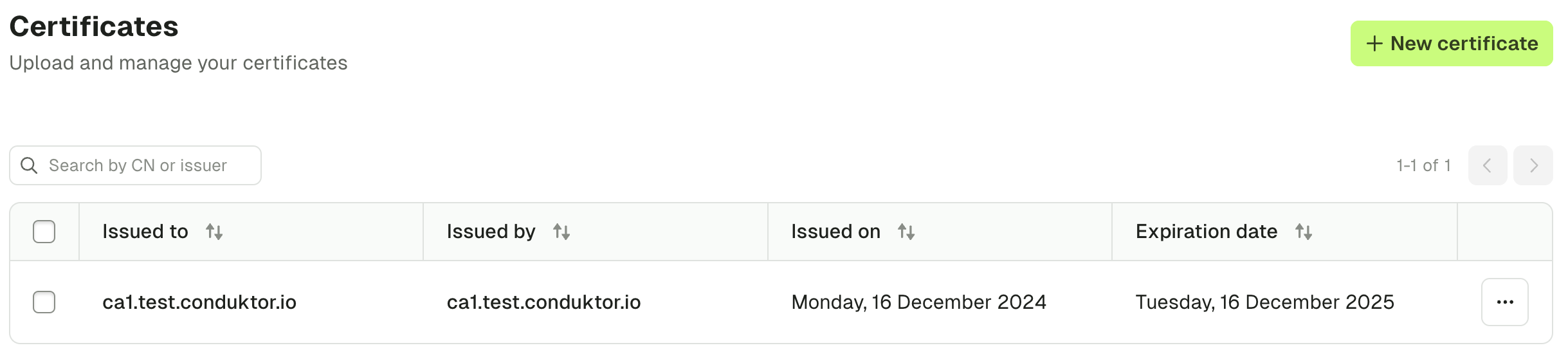
Mount custom truststore
This option is recommended for SSO, DB or other external services requiring SSL/TLS communication.
Create TrustStore (JKS) from certificate in PEM format
If you already have a truststore, you can ignore this step. You need akeytool program that is usually packaged on JDK distributions and a certificate in PEM format (.pem or .crt).
Configure custom truststore via Conduktor Console
Mount the truststore file into theconduktor-console container and pass the correct environment variables for locating truststore file inside the container (and password, if needed).
If the truststore file is truststore.jks with password changeit, mount truststore file into /opt/conduktor/certs/truststore.jks inside the container.
If run from Docker :
Client certificate authentication
This option is recommended for mTLS.
- Mutual SSL, Mutual TLS, mTLS
- Two-Way SSL, SSL Certificate Authentication
- Digital Certificate Authentication, Public Key Infrastructure (PKI) Authentication
Use the UI (keystore method)
Use the keystore file from your Kafka admin or provider (in .jks or .p12 format). Click the “Import from keystore” button to select a keystore file from your filesystem.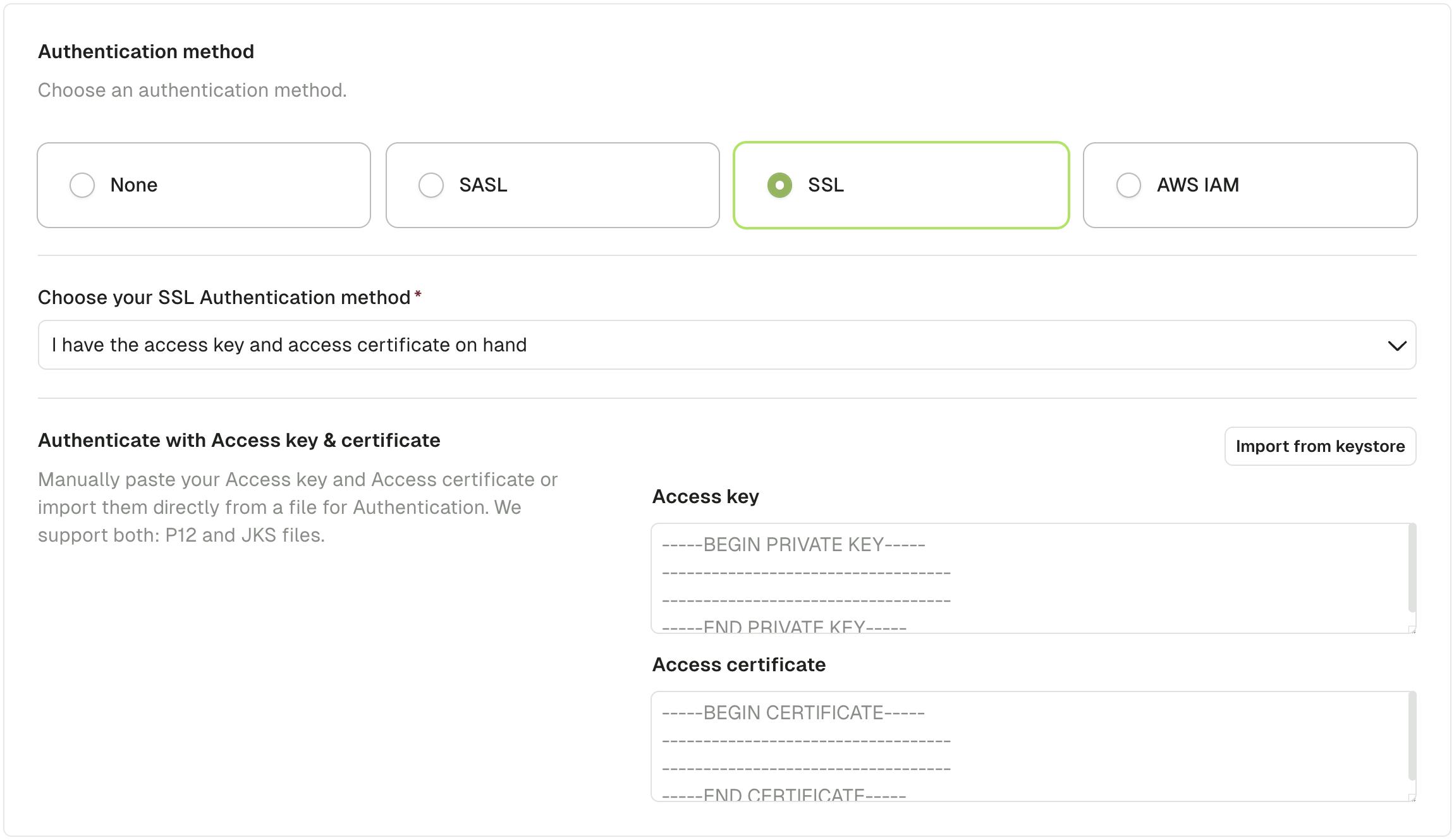
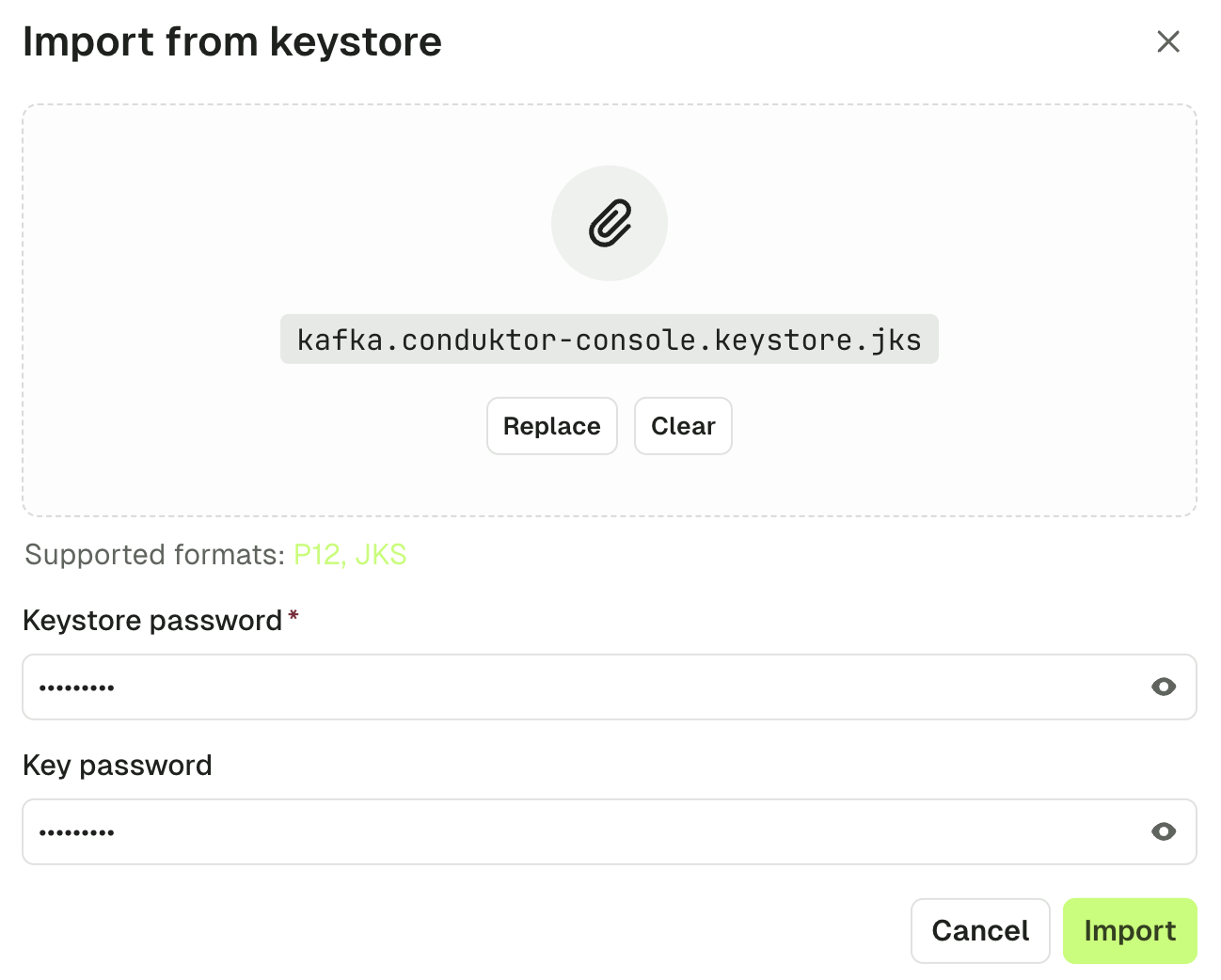
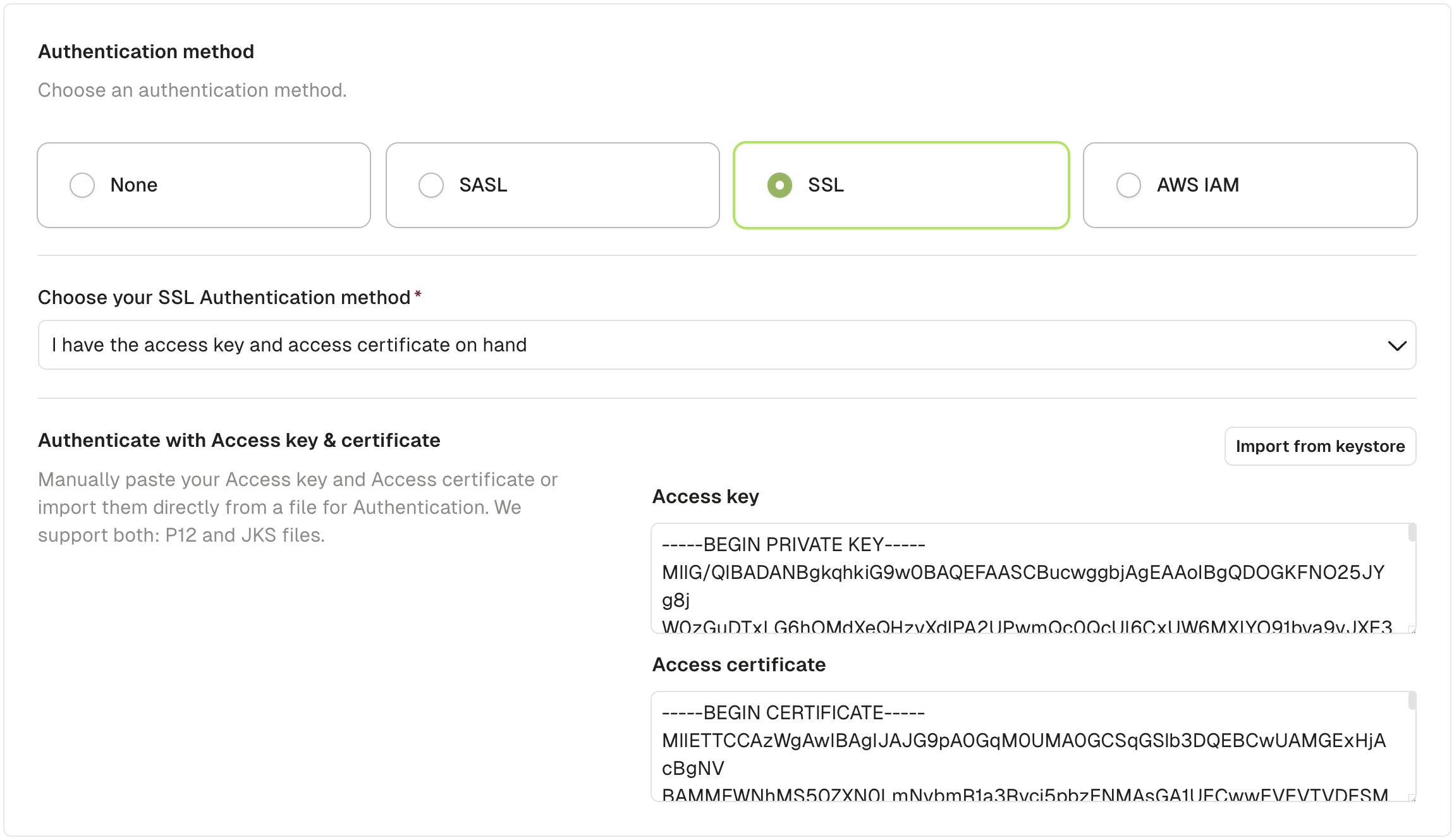
Use the UI (Access key and access certificate method)
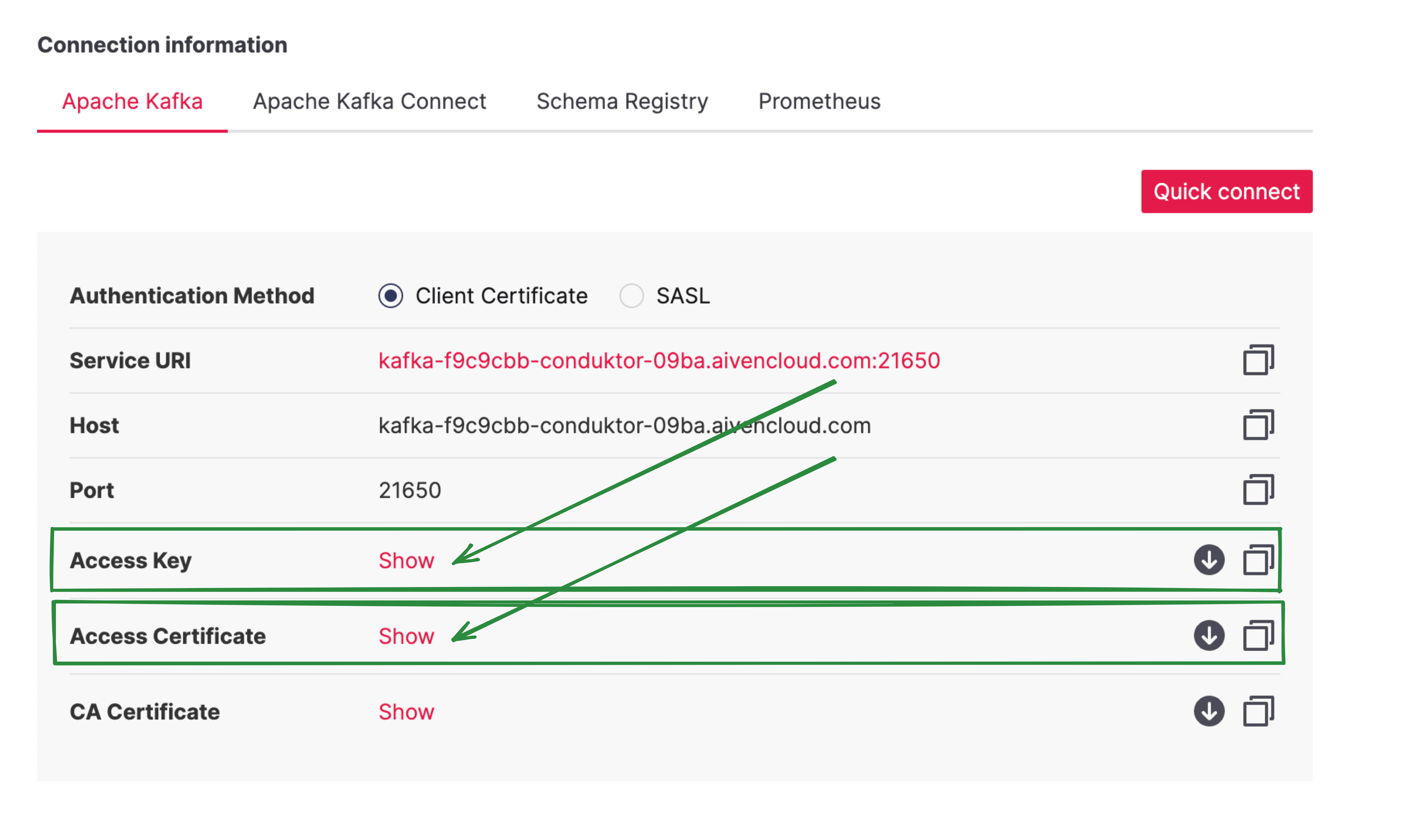
Your Kafka admin or your Kafka provider gave you 2 files for authentication.- An Access key (
.keyfile) - An Access certificate (
.pemor.crtfile)
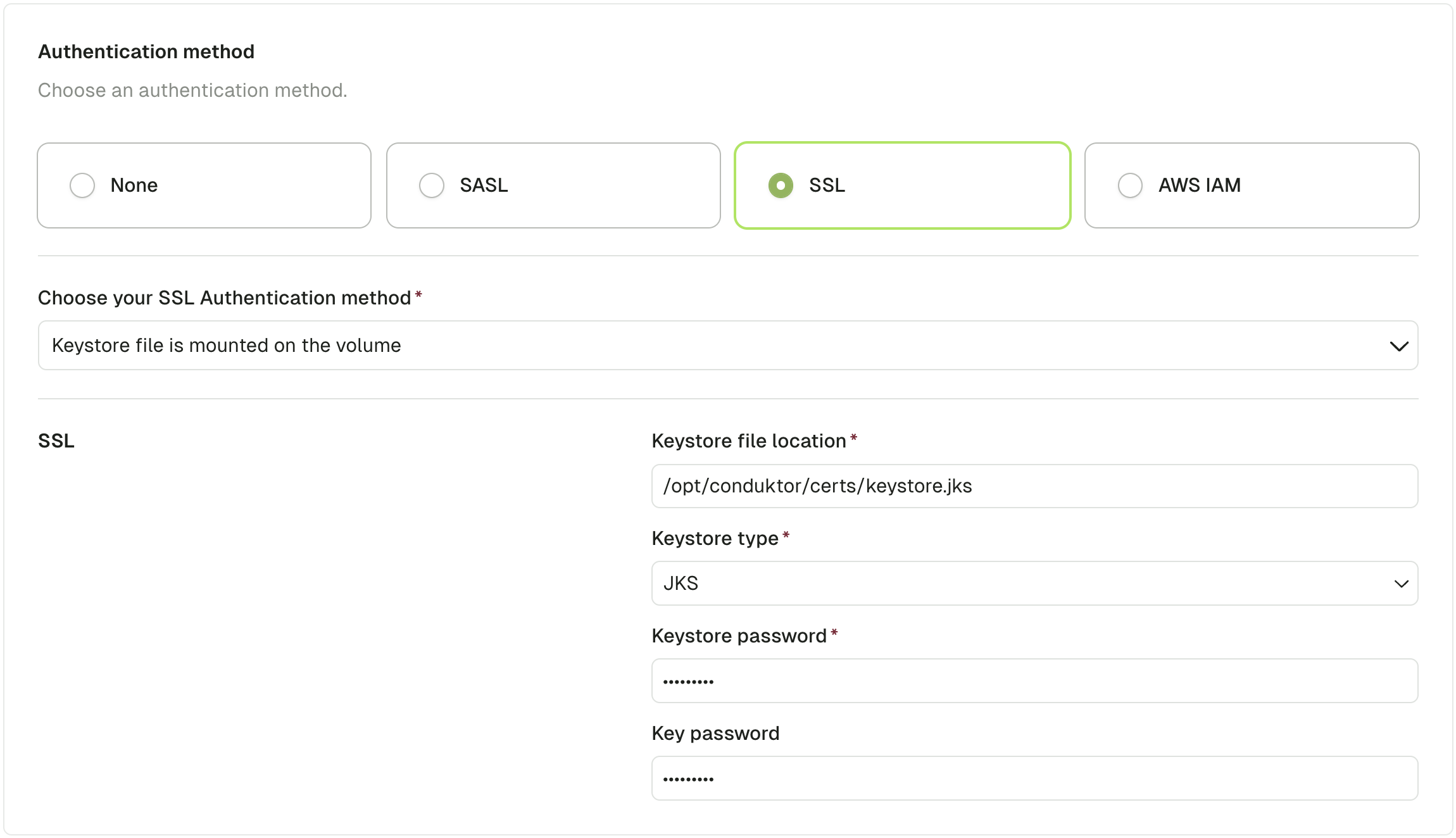
Use volume mount
You can mount the keystore file in theconduktor-console image:
Configure Postgres database
Conduktor Console requires a Postgres database to store its state.Postgres requirements
- Postgres version 13 or higher
- Provided connection role should have grant
ALL PRIVILEGESon the configured database. Console should be able to create/update/delete schemas and tables on the database.
- 1-2 vCPU, 1 GB of RAM, and 10 GB of disk
Database configuration properties
database: is a key/value configuration consisting of:database.url: database connection url in the format[jdbc:]postgresql://[user[:password]@][[netloc][:port],...][/dbname][?param1=value1&...]database.hosts[].host: Postgresql server hosts namedatabase.hosts[].port: Postgresql server portsdatabase.host: Postgresql server host name (Deprecated. Usedatabase.hostsinstead)database.port: Postgresql server port (Deprecated. Usedatabase.hostsinstead)database.name: Database namedatabase.username: Database login roledatabase.password: Database login passworddatabase.connection_timeout: Connection timeout option in seconds
URL format
Console supports both, the standard PostgreSQL URL and JDBC PostgreSQL . Connection username and password can be provided in the URL as basic authentication or as parameters.SSL support
By default, Console will try to connect to the database using SSL modeprefer. We plan to make this configurable in the future along with database certificate.
Setup
There are several options available when configuring an external database:-
From a single connection URL
- With the
CDK_DATABASE_URLenvironment variable. - With the
database.urlconfiguration field. In either case, this connection url is using a standard PostgreSQL url in the format[jdbc:]postgresql://[user[:password]@][[netloc][:port],...][/dbname][?param1=value1&...]
- With the
-
From decomposed configuration fields
- With the
CDK_DATABASE_*env vars. - With the
database.*on configuration file.
- With the
Example
- If all connection URLs and decomposed configuration fields are provided, the decomposed configuration fields take priority.
- If an invalid connection URL or a mandatory configuration field (
host,usernameorname) is missing, Conduktor will fail gracefully with a meaningful error message. - Before Console v1.2.0, the
EMBEDDED_POSTGRES=falsewas mandatory to enable external Postgresql configuration.
Multi-host configuration
If you have a multi-host setup, you can configure the database connection with a list of hosts. Conduktor uses a PostgreSQL JDBC driver to connect to the database that supports multiple hosts in the connection url . To configure a multi-host setup, you can use thedatabase.url configuration field with a list of hosts separated by commas:
targetServerType to specify the target server type for the connection:
targetServerType are supported: any, primary, master, slave, secondary, preferSlave, preferSecondary and preferPrimary.
Debug Console
To troubleshoot Console:- Verify that Console is up and running.
- Check the logs and send them to our support team if necessary.
1. Verify that Conduktor is up and running
- From Docker
- Kubernetes
First, verify that all the components are running.If you’re using an external Kafka installation and external database, you will only need to verify that the You can save these logs in a file:
Get containers status
Output
conduktor-console container is showing healthy as the STATUS.If Console is showing an “exited” status, check the Docker logs by running the command (with the appropriate container name):Get container logs
Store logs in a file
2. Get the logs and send them to support
Logs are kept in/var/conduktor/log. You can see them using:
List log files
Output
Configuration properties and environment variables
For the complete list of variables, see the Console environment variables reference.Configure HTTP proxy
Specify the proxy settings for Conduktor to use when accessing Internet. The HTTP proxy works for both HTTP and HTTPS connection. There are five properties you can set to specify the proxy that will be used by the HTTP protocol handler:CDK_HTTP_PROXY_HOST: the host name of the proxy serverCDK_HTTP_PROXY_PORT: the port number. Default value is 80.CDK_HTTP_NON_PROXY_HOSTS: a list of hosts that should be reached directly, bypassing the proxy, for both HTTP and HTTPS. This is a list of patterns separated by|. Each pattern can start or end with a single*for wildcards: a*alone, a*in the middle and/aren’t supported. This variable replaces the default valuelocalhost|127.*that the container sets, so includelocalhost|127.*in your list.CDK_HTTP_PROXY_USER: the proxy usernameCDK_HTTP_PROXY_PASSWORD: the proxy password
Example
Configure HTTPS
To configure Conduktor Console to respond to HTTPS requests, you have to define a certificate and a private key. The server certificate is a public entity that’s sent to every client that connects to the server and it should be provided as a PEM file. Configuration properties are:platform.https.cert.pathor environment variableCDK_PLATFORM_HTTPS_CERT_PATH: the path to server certificate fileplatform.https.key.pathor environment variableCDK_PLATFORM_HTTPS_KEY_PATH: the path to server private key file
Both the certificate and private key files have to be readable by the user Console runs as (UID
10001 by default) but don’t need to be readable system-wide.Sample configuration using docker-compose
In this example, server certificate and key (server.crt and server.key) are stored in the same directory as thedocker-compose file.
conduktor/conduktor-console-cortex is running as well, you have to provide the CA public certificate to the monitoring image to allow metrics scraping on HTTPS.